
History of the Rossini and Badhotel
History & architectureTwo buildings. Two stories. One hotel.
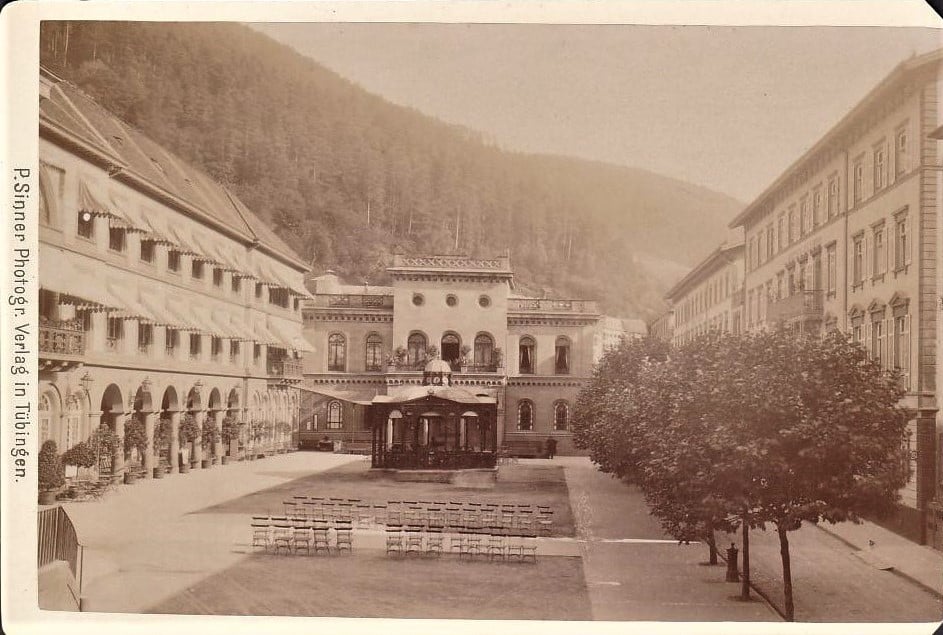
Today, Mokni’s Palais Hotel & SPA occupies two buildings opposite one another, the Rossini and the Badhotel . Now one hotel run by the Mokni family, the two buildings began as separate establishments on Bad Wildbad’s Kurplatz.
Both are closely tied to Bad Wildbad’s development as a spa town. The Badhotel, in particular, has a longstanding connection to the baths next door, which later became the Palais Thermal .
The two hotels developed independently for many decades. From the outset, however, the Badhotel had a special connection to the historic baths next door.
Their stories finally came together under the Mokni family at the beginning of the 21st century.
Hotels and baths grew up around the thermal springs
Long before the two hotels took their current form, Wildbad’s warm springs shaped the town’s development. As its reputation as a spa resort grew, so did demand for modern baths, accommodation and places for visitors to socialise.
In 1824 King Wilhelm I of Württemberg set in motion a major renewal of Wildbad’s spa and bathing facilities. A few years later, plans were drawn up for a new royal spa complex.
Private lodging houses developed on one side of the Kurplatz. On the other, the future Royal Badhotel and the large royal baths were deliberately linked.
Those different origins still shape the Rossini and Badhotel today.

Two hotels with different origins
The left-hand timeline follows today’s Rossini; the right-hand one traces the Badhotel. The Rossini grew out of the traditional hotel trade on the Kurplatz, while the Badhotel was closely tied to the royal baths.
For the story of the historic baths themselves, see our page on the history of the Palais Thermal .
The building now known as the Rossini is built
The historic building on the Kurplatz was erected in 1829 as the König von Württemberg. Originally three storeys high, it forms the historic core of today’s Rossini.
Its location in the heart of the growing spa town soon made it part of the hotel trade serving Wildbad’s many spa visitors.
The Badhotel and the baths form a single complex
The Badhotel’s origins differ markedly from those of the hotel across the square.
As part of the modernisation of Wildbad’s spa facilities launched by King Wilhelm I, the royal court architect Nikolaus Friedrich von Thouret submitted plans for a new bathhouse and spa hotel in 1837.
In the early 1840s, the existing royal palace was converted into the Royal Badhotel. The large royal bathhouse was completed next door by 1847; it later became today’s Palais Thermal .
A defining point in the hotel’s history: The Badhotel and the baths were not neighbours by chance. They were part of a single royal spa complex. Records show a direct connection between hotel and bathhouse as early as the 19th century.
Gioachino Rossini stays in Wildbad
In 1856 the celebrated Italian composer Gioachino Rossini came to Wildbad for a spa stay and lodged at the then Hotel Bären, today’s Rossini building.
His visit remains one of the hotel’s most distinctive ties to the history of the spa town.
From the König von Württemberg to a larger hotel complex
The König von Württemberg had ceased operating as an independent inn before 1860, but its rooms were still let to spa visitors.
Later in the 19th century, the building became part of the growing Hotel Klumpp / Bären complex. The sources available so far do not establish exactly when this happened.
The next major structural change is documented: In 1879 a fourth storey was added to the original three-storey building.
1879
A historic façade, a new hotel building
In 1960 most of the 19th-century Badhotel was demolished. The neoclassical façade, with its distinctive arcade facing the Kurplatz, was among the parts preserved.
A new hotel rose behind the historic façade in the early 1960s. The large rear wing is documented as having been built in 1962.
Today’s Badhotel thus combines 19th-century architecture with a mid-20th-century hotel building.
The present-day bathrobe corridor should not be understood as a 19th-century passage preserved unchanged. What dates much further back is the direct connection between the hotel and the bathsitself.
The Badhotel stays open as the historic baths close
1978 marked an unusual break in the long connection between hotel and baths.
When the new spa treatment centre opened, most of the bathing areas in the former Graf-Eberhard-Bad were taken out of use. The Badhotel immediately next door continued operating independently as a hotel.
For years, the Badhotel therefore stood beside a historic bathhouse that was largely no longer used for bathing.
The full account of this period is part of our history of the Palais Thermal .
The Mokni family takes over Hotel Bären
1993 marked the start of the Mokni family’s career as hoteliers on Bad Wildbad’s Kurplatz, when they took over the former Hotel Bären.
The hotel was closed at the time. The family extensively renovated it and reopened it as a hotel.
Still an independent hotel
The Badhotel opposite was not yet part of the Mokni family’s hotel business.
The two hotels continued to operate separately for the time being.
The historic baths reopen
After extensive restoration, the former Graf-Eberhard-Bad reopened in December 1995 under a new name: Palais Thermal .
The historic link between the Badhotel and the baths took on new significance, around 17 years after most of the original bathing areas had been taken out of use.
The full story of how the centuries-old baths became today’s Palais Thermal is on our history of the Palais Thermal page .
Run by the Mokni family since 1993
By this time, the Mokni family had been running the former Hotel Bären for many years.
The Mokni family also takes over the Badhotel
In 2007 the Mokni family also took over the long-established Badhotel across the square.
The building needed substantial renovation after years of underinvestment. Over the following years, technical installations, utility lines and hotel areas were thoroughly renewed.
For the first time, both historic hotels on the Kurplatz were in the hands of the same family.
Two hotels become one business
In 2008 the former Hotel Bären was renamed Rossini Hotel. The Rossini and Badhotel were brought together under the name Mokni’s Palais Hotels & Spa.
Meanwhile, major refurbishment work was under way at the Badhotel. Extensive renovation and modernisation followed over the next few years.
The two hotels, independent for many decades, gradually became one business run by the Mokni family.
Two buildings complement each other
Under shared management, the day-to-day functions of the two buildings grew closer. Rather than running two entirely separate hotels, the family brought the strengths of each building together.
Today, the Rossini building houses the central reception and serves breakfast for guests of both buildings.
The Badhotel building continues a historic tradition. Today, guests take a direct bathrobe corridor to the adjoining Palais Thermal .
What is now a distinctive convenience for hotel guests has historic roots: the 19th-century Royal Badhotel was already connected to the neighbouring bathhouse.
Note on the historical sources
The long history of both buildings was reconstructed from historical descriptions of the town, heritage records, archival references, contemporary publications, public documents, specialist literature and other historical sources.
Not every 19th-century change of ownership or name can be assigned an exact year. In particular, the date when the former König von Württemberg became part of the Hotel Klumpp / Bären complex is not clearly documented. Where the sources do not establish a date, we deliberately avoid suggesting one.
A direct link between the Royal Badhotel and the neighbouring bathhouse is documented in the 19th century. However, the Badhotel was largely rebuilt in the 20th century, so the modern bathrobe corridor is not necessarily an intact passage from that period.
For the full construction, bathing and restoration history of the neighbouring bathhouse, see our page History of the Palais Thermal in the Black Forest .
One hotel. Two buildings. One family.
Today, the two buildings across the square, the Rossini and the Badhotel , together form Mokni’s Palais Hotel & SPA .
. Each has its own story and strengths. Both are now part of one family-run hotel managed by the Mokni family.
Reception and breakfast are at the Rossini, while the Badhotel offers direct bathrobe access to the Palais Thermal , continuing a connection whose origins reach back to the 19th-century royal spa complex.
Two buildings with almost two centuries of history, now one hotel.
Explore our two buildings